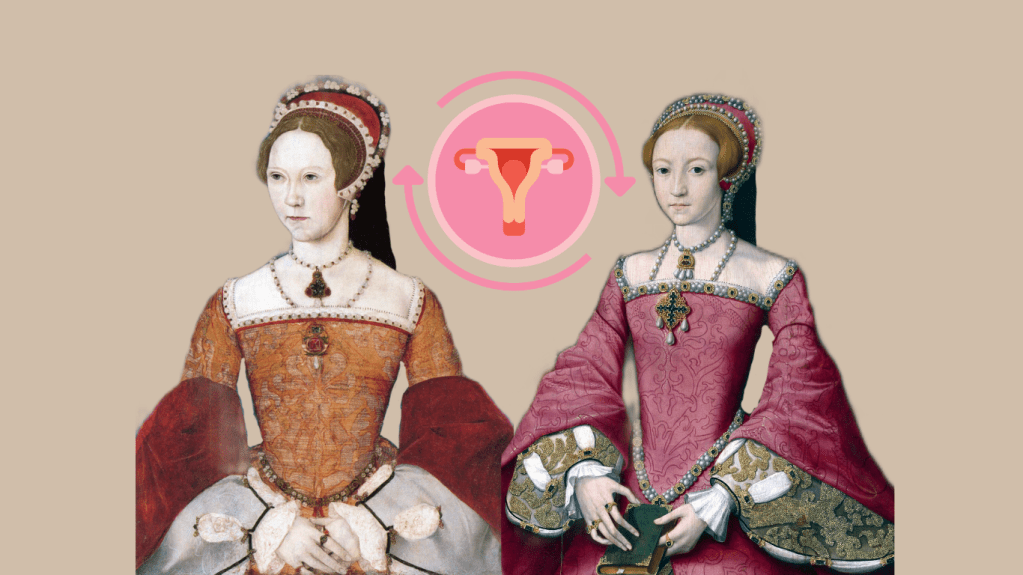
Since the fifteenth century, the physical health of the Tudor Queens has been long discussed. As pressure mounted to expand the Tudor dynasty, the conversations surrounding their health often focused on their fertility whether it was from the King, nobles, and later, historians. Naturally, historians have focused on their pregnancies due to the significant impact it had on their lives and status, particularly, the struggle to give birth to a son. However, if we steer the conversation slightly to focus on what symptoms and issues Mary I and Elizabeth I had with their periods, it will show how they went through similar issues as women in the 21st century.
It is well known that both Catherine of Aragon and Anne Boleyn had problems with multiple miscarriages and stillbirths. Some historians believe that this was due to Henry VIII carrying a rare blood type causing issues within pregnancy (some say he was Kell positive and others say he was RH positive, but both are similar). However, the menstrual cycles of Catherine and Anne was not regular which may have contributed to their struggle to conceive. With Mary I and Elizabeth I, they had hormonal and gynecological problems long before their fertility ever came into question.
Mary I dealt with many illnesses since she was young. Her symptoms included irregular, painful menstrual cycles, abdominal swelling and even lactating breasts. Elizabeth I also had similar symptoms such as, irregular periods, migraines and digestive issues. Mary I’s health and her issues with her menstrual cycle did not improve and she died in 1558 with what is now believed to be either womb or uterine cancer. Elizabeth I did not marry and there is a theory that this was because she knew she would be unable to have children due to her hormonal and gynecological problems. It is also possible that she knew how much her sister struggled with her pregnancies and believed she may experience the same. However, this is purely speculative and to my knowledge, there is no evidence to suggest she thought this way.
With the advancement of modern science, we now know that there are many conditions which affect hormonal and gynecological health such as, Polycystic Ovary Syndrome (PCOS), Endometriosis, thyroid problems and even pituitary tumors. These conditions fit the symptoms that Mary I and Elizabeth I had, specifically Endometriosis and PCOS which can also be genetic. Therefore, as their mothers had problems with their hormonal health, it is possible they may have had these conditions which was them passed down to their daughters. However, it is easy to place a modern diagnosis onto them and so, it is important to remember that we currently do not truly know what conditions they had.
There is not much information on how Elizabeth I coped with her cycle and symptoms. Or whether this was an aspect of her life that she discussed with her sister. There is also little information about the remedies and treatments they may have taken.
Despite this, what Mary and Elizabeth went through, physically and mentally, will resonate with many people today. These Tudor Queens had little medical support to help them through their symptoms. Doctors and the people around them solely focused on their fertility which is on par with what people experience in the 21st century regarding their hormonal and gynaecological health. In fact, I came across a thread about Endometriosis which had this exact discussion!
Thankfully over the past few years, there has been more of a focus on Mary and Elizabeth’s health which is not just focused on their fertility and pregnancies. It is a reminder that these conversations need to shift slightly to include every aspect of their health and who they were. It is just one way for people today to be able to relate to historical figures.
References
How an Endocrine Disease may have shaped British History
The Illness, Death and Burial of Mary I
Genetic Basis of Polycystic Ovary Syndrome (PCOS): Current Perspectives
 Hidden History by Eesha
Leave a comment