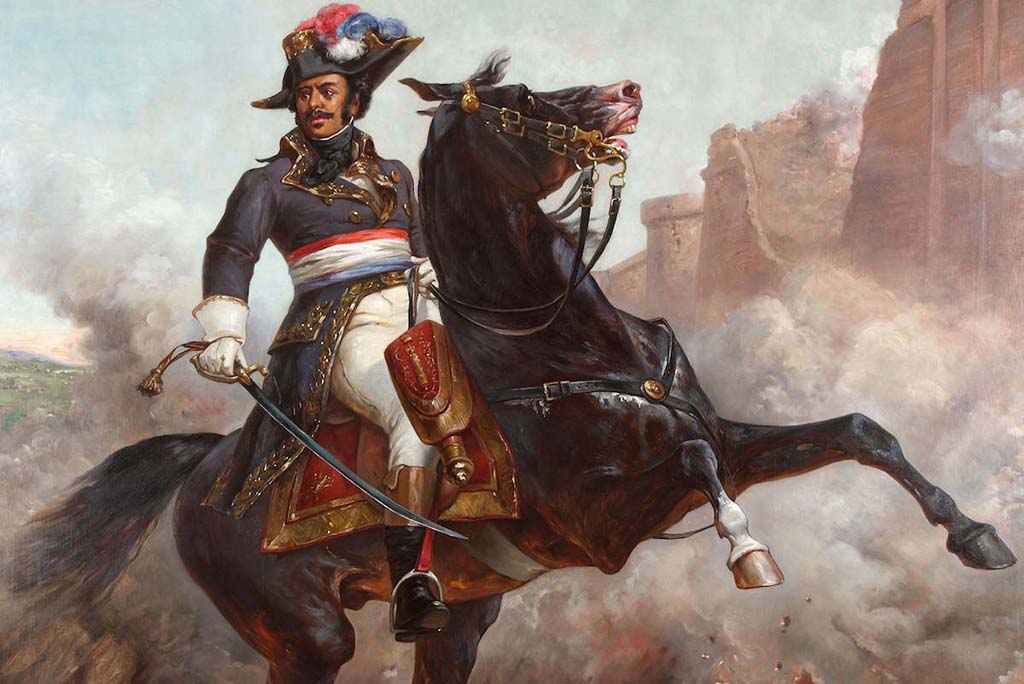
Did you know that the father of Alexandre Dumas, author of The Three Musketeers, was a Black General who worked with Napoleon Bonaparte?
Thomas-Alexandre Dumas was born in 1762 to an enslaved Black woman, Marie-Cessette Dumas, and to a white Frenchman, Alexandre Antoine Davy de la Pailleterie
Born in Saint-Domingue (now Haiti), Dumas was taken to France by his father aged 14 and he was never to see his sisters or his mother again. Despite this, Dumas was given a good education and taught swordsmanship from the Chevalier de Saint-Georges, who was another mixed raced man.
During his mid-20s, Dumas joined the French army. However, due to his race, he was only allowed to join the lowest rank. Coming from a well-known family, his father did not want his name attached to a son with a low rank. Therefore, Thomas-Alexandre signed up with his mother’s maiden name ‘Dumas.’ Making him Alexandre Dumas, or Alex Dumas.
Almost a decade after joining the army, he worked his way up and became the lieutenant of The Black Legion – a legion in the army for free men of colour/mixed race people and he was later promoted to General.
Once promoted to General, Dumas married Marie-Louise, a white woman, and they had three children together. The youngest being the famous author, Alexandre Dumas.
A few years later, Dumas served under Napoleon Bonaparte in the Army of Italy and it is believed the two generals did not get along, potentially due to jealousy. Dumas was a tall man with excellent military skills. His dedication to building up his status and title through the army ranks also impressed many. Although there was tension between the two, Dumas continued to serve under Napoleon and travelled with the army to Egypt. On his travels back to France, he was imprisoned for two years under the Holy Faith Army, an army that had been working with France’s enemy, the Kingdom of Naples.
After his release, he returned to France. As Dumas was not awarded his pension, found himself struggling to support his family financially. His pleas to Napoleon fell on deaf ears but he continued to fight for his pension rights until his death.
He died in 1806, leaving behind his wife, two daughters, and a son. Marie-Louise lived until she was around eighty years old and was able to tell her son stories of his father. Alexandre Dumas (Author) took great pride in sharing his father’s life and incorporated the stories into many of his books.
The life of General Dumas is a fascinating one. He was heavily involved in France’s military campaigns and his leadership was respected by many. Despite his rich history, particularly when related to Napoleon Bonaparte, many people are unfortunately unaware of who he is or the impact he had on the French Black community in the eighteenth century.
If you would like to learn more, I would highly recommend reading The Black Count: Glory, Revolution, Betrayal, and the Real Count of Monte Cristo by Tom Reiss!
 Hidden History by Eesha
Leave a comment